Quick answer: Section 179 is a federal tax deduction that lets a business deduct the full purchase price of qualifying equipment, including financed or leased equipment, in the year it's placed in service. For 2026, the Section 179 deduction limit is $2,560,000, with the phase-out threshold starting at $4,090,000. Beacon Funding finances tow trucks, septic pumpers, and embroidery and screen-printing equipment that can qualify for the Section 179 deduction.
Example: A $250,000 equipment purchase at a 35% tax bracket could generate roughly $87,500 in first-year tax savings, cutting the effective cost to $162,500.
Listen to the podcast episode
Prefer to listen? Tune into this episode of The Equipment Finance Navigator for the full breakdown about Section 179.
In this article…
- What Is Section 179 Deduction?
- Why Section 179 Matters for Small Businesses
- How to Calculate Your Potential 2026 Section 179 Tax Savings
- What is the Section 179 Deduction Limit for 2026?
- 2026 Section 179 Deduction Limit vs. Prior Years
- Do You Qualify for the Section 179 Deduction?
- How Financing + Section 179 Work Together
- Why Acting Early Matters
- Get Started Financing Equipment Today
- Frequently Asked Questions
- Disclaimer
What Is the Section 179 Deduction?
Section 179 lets a business deduct all or part of the purchase price of qualifying equipment (including equipment that’s financed or leased) in the year it’s placed in service.
Instead of spreading depreciation over several years, you take the full deduction upfront. For most businesses, that means:
- A stronger cash position
- Lower taxable income
- Faster reinvestment into payroll, materials, or additional equipment
It’s one of the most widely used tax tools for small and growing businesses.
Example: Section 179 Tax Deduction Estimate for a $250,000 Equipment Purchase
| |
Amount |
| Equipment Cost |
$250,000 |
| Estimated Section 179 Tax Savings |
$87,500 |
| Equipment Cost After Tax Savings |
$162,500 |
This is a simplified Section 179 tax savings example assuming a 35% tax bracket and an equipment cost of $250,000. Actual savings depend on your tax bracket, total qualifying purchases, and how Section 179 interacts with bonus depreciation*.
6 Key Benefits of Section 179 Tax Savings
- Immediate tax savings: reduce your tax liability the same year you finance equipment with Beacon Funding*.
- Lower upfront cost: write off 100% of qualifying equipment purchases in year one.
- More cash on hand: free up funds to spend on other parts of your business.
- Equipment upgrades: get the equipment you need and let Section 179 lower your business income taxes at the same time.
- Room to expand: reinvest your Section 179 savings into business growth.
- Competitive edge: Section 179 frees up more cash to keep investing in your operation.
LEARN MORE ON SECTION 179
Why Section 179 Matters for Small Businesses
Taking the Section 179 tax deduction now instead of later can meaningfully change your day-to-day cash position. Section 179 helps American businesses by:
- Reducing taxable income immediately
- Keeping more cash available for surprises and opportunities
- Making essential upgrades affordable without draining reserves
- Encouraging faster growth by putting equipment to work right away
How to Calculate Your Potential 2026 Section 179 Tax Savings
Want to see how much you can save on your taxes if you add equipment this year? Enter your equipment cost into Beacon Funding’s free Section 179 calculator to get an estimate of your potential income tax savings.
CALCULATE MY SECTION 179 TAX SAVINGS
What is the Section 179 Deduction Limit for 2026?
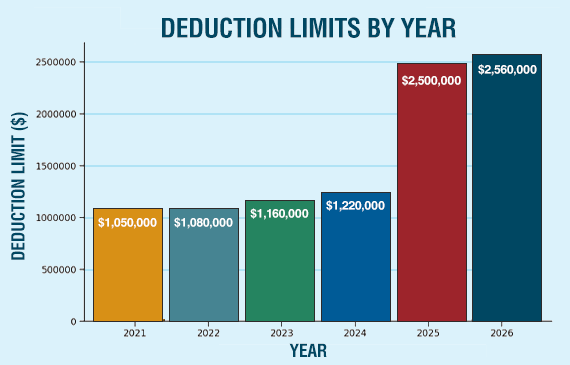
For 2026, the IRS has set the Section 179 deduction limit at $2,560,000 (a $60,000 increase over 2025’s $2,500,000 limit). Most small and mid-sized businesses, who finance under the Section 179 limit, can expense 100% of their qualifying equipment purchases in 2026.
The Section 179 phase-out threshold starts when your total qualifying equipment purchases exceed $4,090,000. Section 179 deduction is then reduced dollar-for-dollar for any amount over the phase-out threshold.
2026 Section 179 Deduction Limit vs. Prior Years
| Year |
Deduction Limit |
% Change |
$ Change |
| 2026 |
$2,560,000 |
+2.4% |
$60,000 |
| 2025 |
$2,500,000 |
+104.91% |
$1,280,000 |
| 2024 |
$1,220,000 |
+5.17% |
$60,000 |
| 2023 |
$1,160,000 |
+7.40% |
$80,000 |
| 2022 |
$1,080,000 |
+2.85% |
$30,000 |
| 2021 |
$1,050,000 |
--- |
--- |
The 2025 jump reflects the One Big Beautiful Bill Act (OBBBA), which significantly raised the Section 179 deduction limit and made it, along with the phase-out threshold, a permanent, inflation-adjusted part of the tax code going forward.
Do You Qualify for the Section 179 Deduction?
To claim Section 179 in 2026, your equipment needs to meet three requirements:
1. Placed in service by December 31, 2026
Financed equipment and lease-to-own agreements qualify. But the equipment must be in use by year-end, not just ordered or awaiting delivery.
Ready to Save with Section 179?
Unlock potential tax savings this year by financing your equipment purchase.
Apply for equipment financing now to ensure your purchase qualifies for Section 179 before December 31, 2026.
START APPLYING NOW
2. New or used equipment qualifies
Common Section 179 qualifying equipment examples include:
3. Used for business at least 50% of the time
Always confirm eligibility with your CPA before finalizing a truck or equipment purchase.
Ready to Save with Section 179?
Unlock potential tax savings this year by financing your equipment purchase with Beacon Funding; applying is cost- and commitment-free.
Apply for equipment financing with Beacon Funding now to ensure your purchase qualifies for Section 179 before December 31, 2026.
How Financing + Section 179 Work Together
Pairing equipment financing with Section 179 is one of the most efficient ways to expand without draining cash reserves:
- Spread cost over low monthly payments while still taking the full tax deduction upfront
- Improve cash flow by cutting taxable income immediately
- Keep credit lines open for materials, hiring, or unexpected costs
- Simplify budgeting with low monthly payments
For many businesses, financing + Section 179 means acquiring equipment now while staying prepared for whatever the rest of the year brings.
Why Acting Early Matters
If you want the 2026 deduction, timing matters. Your equipment has to be purchased, delivered, and in service by December 31, 2026.
Some equipment (especially trucks and specialty machinery) can have long lead times. Planning ahead now helps make sure you don’t miss the window.
Get Started Financing Equipment Today
As the industry leader in equipment financing, Beacon Funding helps you secure the equipment you need with low monthly payments while keeping you positioned to take full advantage of Section 179.
GET STARTED NOW
Frequently Asked Questions
1. What is the Section 179 phase-out threshold for 2026?
The 2026 phase-out threshold is $4,090,000. If your total qualifying equipment purchases exceed that amount, your deduction is reduced dollar-for-dollar.
See our Section 179 infographic for the full breakdown.
2. Does financed equipment qualify for the Section 179 deduction?
Yes. Specific equipment purchased through financing or lease-to-own structures can qualify, as long as it’s placed in service by December 31, 2026.
Get in touch with a professional at Beacon Funding today!
3. Does Section 179 apply to used equipment?
Yes. Both new and used equipment qualify, provided the equipment is new to your business and meets IRS requirements.
Check out Beacon Funding’s infographic for more information!
4. How does Section 179 impact cash flow?
By letting you deduct the full equipment cost upfront, Section 179 lowers taxable income immediately, freeing up capital for payroll, operations, or your next purchase.
Try Beacon Funding's Section 179 calculator to see your estimate.
5. Should I talk to my CPA before using Section 179?
Yes. Section 179 can deliver real tax savings, but eligibility and impact depend on your specific tax situation*.
Disclaimer
* Be sure to check with your CPA or tax professional before you finalize an equipment purchase.